
Left Behind
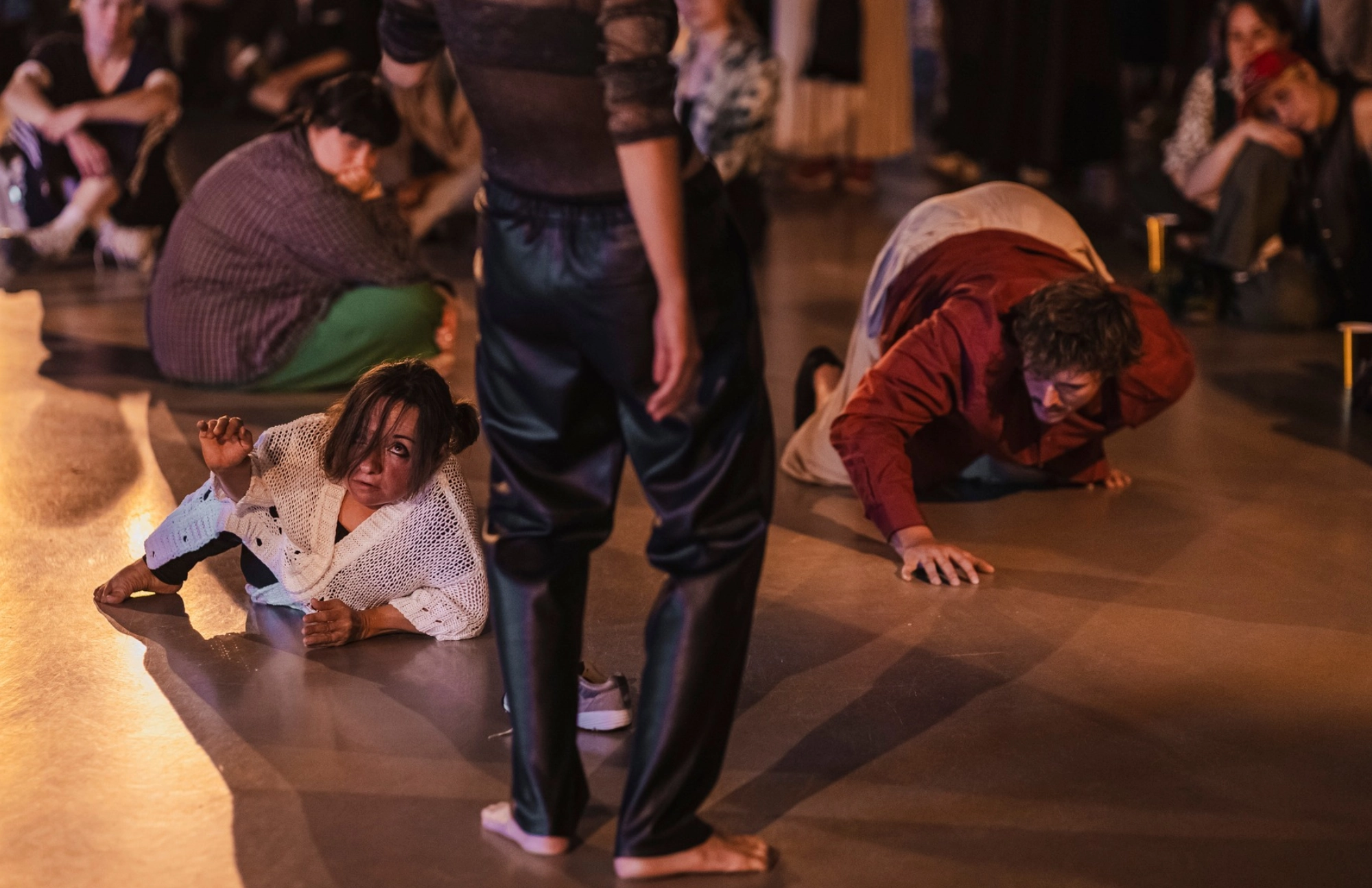
photo Akseli Muraja
LEFT BEHIND
New Production 2025/2027
Left Behind is Chiara Bersani’s new project leading to the creation of a production for three to five performers: among them some will be with motor disability. Drawing inspiration from the conventions of the horror genre, the artist explores whether certain marginalized groups can generate fear, as well as experience it. The research explores the imagination of the future from the perspective of communities of people with disabilities. A future not built on force, but on transformation. On the dismantling of heavy-handed policies. On a different conception of bodies, relationships, and the world. In the realm of the repressed, fear becomes a field of affirmation, a place of potential assertion. The performance interrogates the present. Zombies are the starting point: bodies that never stop moving. Performers with and without disabilities become zombies. They walk. They keep going. A misplaced gesture. A parasitic action in public space, where something else is already happening. They ask: who are our zombies? What kind of zombies are we becoming? Walking becomes an exercise. A way to stay. A way to move forward. And perhaps, simply, an invitation: is it possible to desire to become like us? What does it mean to keep moving forward, when moving forward seems the only possible form of existence?
In essence, the research explores fear as an agent, a catalyst for a collective and generative process.
The work will follow many creative stages during which the cast will be selected, and the final form of the show will be decided. One of these stages envisages some research on movement and experimentation in a swimming pool, which could be the place where the performance or one of its versions will be staged.
Author’s Premise
This is not the time when I wanted to be an adult.
The world is just rubble, the tragedies are told with words lacking in strength, transforming them into rhetoric is only a way to spend the night.
I can’t stand slogans, and I don’t understand dictionaries when they age quickly.
The words I fall for are those that remain stratified and fresh for decades, and there aren’t any now.
Perhaps, in times like these, there is no space to find any.
The poetics of the end of the world, of the rubble, of the catastrophe is inacceptable now.
The affected solace of care is a lie that makes the ears bleed.
We live in a time made of blades; we are scared but don’t even know what it means exactly. After all, it is not we who are bombed.
This is what my new work speaks of. Fear.
I wish to make a performance that follows the mechanism of the horror genre. A show setting out from our comfortable Europe – where many impaired people still live segregated, where many people have been made invisible, where, until a few years ago in some countries, they were castrated – and you can’t find a comfortable final resolution.
I have always comforted; I have always wanted to comfort, because many impaired women are terrified by the idea of being left behind. The possibility of being abandoned leaves me breathless.
But if I give it a better look, if I dry my eyes, so many of us are left behind that the word “loneliness” becomes meaningless.
The Space
A swimming pool.
Perhaps an aqua gym class.
Anyone can swim in a swimming pool. Anyone can float.
The heaviness of the bodies disappears. The spasms soften.
Anyone can be happy in a swimming pool, only for some it’s the sole place where movement is possible.
The swimming pool has contours.
Edges.
A swimming pool can be freedom and a prison.
It has an outside and an inside.
A top and a bottom.
Life in the water is something that must be dealt with on the surface.
The Cast
This project entails teamwork: 5 persons.
I don’t know yet if all of them with physical impairment. Partly this will be decided during the meetings. Surely three will be impaired. All the performers must be able to swim.
Theoretical References
This section refers to the first readings, writings, images and reflections made around the project.
None of them claim to be an example of the work but only of the materials the author started off with
Exhibit n.1
October 2023
My first solo show opens at the Kunsthaus Baselland in Lausanne.
It’s the night of the opening, F, a dear friend who has been following my work for a few years, walks among the paintings and the large carpet composing the exhibition. The two rooms are still almost empty, it’s just she and I and another few people.
She is walking around, while I stand aside.
She walks away and then comes back.
She says: how many impaired potential artists haven’t we listened to? How many lost voices? How different would our thought be now, if they had been able to speak?
If we speak about the impaired, we speak about ghosts.
Those of today but first, first and foremost, those who have gone by.
We have lost poems, songs, perspectives, philosophical intuitions, scientific insight.
What does moving in a public space mean after defining oneself an impaired artist?
After accepting impairment as an identity trait and a working method?
It means walking on a chasm.
Like that day on the crater of the volcano in Iceland. My friends were exploring, I was still, staring into the void. Soon after I would see a geyser.
Where have those voices gone?
Can I really pretend to belong to group without a past?
Without ancestors?
Without songs?
Without ancient slogans?
Without heroines and heroes?
Or perhaps should I look for them in the chasm beneath us?
Exhibit n.2
After reading Woodworm by Layla Martinez, Carrie by Stephen King, We Have Always Lived in The Castle by Shirley Jackson and The Lame Shall Enter First by Flannery O’Connor
“They all hate us in the same way they are all sickened by us in the same way and that disgust gets into us and poisons us and we have it inside so deep that in the end we think it’s ours but it isn’t. And then I fell asleep and when I woke up I had a woodworm inside, which I don’t know if the shadows of the night put it in there among their whispers or whether it entered my head on its own but it doesn’t matter because I understood that I had to get that woodworm out anyway and I couldn’t leave work yet as I had something to do.”
Woodworm – Layla Martinez
In this book, too, as in We Have Always Lived in The Castle by Shirley Jackson there’s a house inhabited by women – women in these frightful books written by visionary women are always connected to dwellings, which often become prisons and sometimes shelters. Not all the women are alive, but they are all frightful and frightened. They are all angry. The only one who wasn’t, here in this extract becomes so. Here the world put in her head a woodworm, which was a woodworm by class and genus and she would do the only thing she could to put things back to balance …or perhaps to unbalance everything forever, but anyway the horizon line was already definitely damaged for generations. Here she would kill.
As Carrie by Stephen King.
That girl from Chamberlain, Maine, could be an impaired girl from the deepest corners of Italy (in this case, it matters little whether it’s north or south), among obsessed Catholics and loneliness and then, one day, she would carry out a carnage in her school.
The day of the ball.
When everyone loved everyone. Except her.
I read Carrie at the beginning of the pandemic and thought “why aren’t you afraid of impaired abandoned people?”
It’s loneliness that generates painful thoughts. It’s the painful thoughts that generate violent thoughts.
Why aren’t you afraid of the impaired?
One day, in the middle of a meadow in sunny Bobbio, my screenwriting teacher said to me in disbelief, “I can’t believe you have never read Flannery O’Connor, when you read it, you will go insane.” And it was true. I started with The Lame Shall Enter First and I remember thinking that I would have never believed there was someone able to tell that story.
The rage.
The rage of the bodies to which any easy solution is put forward.
The rage of Rufus Johnson.
The rage of those who long for the complexity of life but are asked to settle for less socially impacting strategies.
There, an impaired teenager, clever and mystical, emotionally tortures a compassionate man – because he never wanted compassion – and unwillingly pushes the man’s son to commit suicide. It’s a complex short-circuit the one through which Rufus revolts against hypocrisy reaching extreme bitterness, and yet while you read it, you think “Yes” it makes sense.
As Carrie’s rage.
A woodworm.
The world is full of unexploded human beings. Blankets and pillows are thrown upon.
The hypocrisy of the treatment, may softness smother them.
Why aren’t we afraid of them?
Exhibit n.3
Spring 2024
I am driving along a road full of bends. The sun is slightly blinding, our shoulders are cold, the heat on our faces. The sea, we think, after all it is not so far.
Italy is a tired backbone; the mountain chains are only zips between the seas. Its bones melt under this new sun, and we drive on them knowing that we will be among the last to sea their frozen contours.
G, next to me, says “I would like you to hear a song, I think it is perfect for the new work.” Then she tells me about the singer. I like to hear her narrate; she always knows the stories hidden behind things.
“She died” she says, “The entire music community mourned her.”
While I drive, I think that I want to mourn her, too.
I feel that the moment we’re living will become important for me and for G.
We have been travelling together for seven years, we have shared beds, rooms, planes and cars. We have spent silent evenings and sleepless nights, full of words.
We should be the protagonists of a film G and I.
The world should see this moment of beauty, we in this car with the sun making the mountains shine and music coming out of the mobile phone.
Exhibit n. 4
The song
Tears in the Typing Pool
Succumb to the line
The finishing time
The long distance runner
Has stopped on the corner
But I won’t give up
Although I’ve stopped too
Before the end of me and you
The patchwork explains
The land is unchanged
Interpret the rooms
My tears in the typing pool
The letters are sighing
The ink is still drying
I told you the truth
And now I sigh too
The page turns on me and you
Across that white plain
The land is unchanged
Credits
Creation and concept Chiara Bersani | Performance TBD 5 performers | Sound Lemmo | Technical Direction Valeri Foti | Care and Promotion Giulia Traversi | Communication Dalila D’Amico | Organisation and Logistics Eleonora Cavallo | Production Corpoceleste C.C.00# | Co – production to be confirmed
With the support of:
2026 Call for Proposals – Accessibility for Disabled Artists in Live Performance (Bando per l’accessibilità di artiste/i con disabilità allo spettacolo dal vivo – 2026)
promoted by the Directorate-General for Live Performance (Direzione Generale Spettacolo) of the Italian Ministry of Culture (Ministero della Cultura)